7 Kitchen Renovation Mistakes Australians Make (And How to Avoid Them)

Why So Many Australian Kitchen Renovations End in Regret
If you’ve ever stood in a beautifully staged display kitchen and thought, “yes, that’s exactly what I want,” you already understand the excitement that comes with planning a kitchen renovation. Kitchens are, without question, the beating heart of an Australian home. They’re where the coffee gets made before school runs, where Sunday roasts come together, where family arguments get resolved over a bowl of pasta. It makes sense that so many Australians are willing to invest serious money into getting them right.
And the investment is growing. Australian homeowners spent over $48 billion on home improvements in 2025, with kitchen renovations averaging around $27,500 — and climbing. In Sydney and Melbourne, it’s not unusual for a mid-to-high-range kitchen to clear $50,000. A luxury fit-out? Easy $70,000 and beyond.
Yet despite this level of financial commitment, a surprisingly large number of homeowners walk away from the project with regrets. Nearly one in four Australian renovators reported regrets about their project in 2025, and most of those regrets weren’t about the tiles or the tap colour — they were about planning failures, budget blowouts, poor contractor choices, and functional layouts that looked great in a showroom but didn’t actually work for real life.
The good news? Almost every common kitchen renovation mistake is entirely avoidable with a bit of foresight and the right information. Whether you’re planning a modest refresh or a complete gut-and-rebuild, this guide will help you navigate the process smarter. We’ll cover the seven biggest mistakes Australians make, share layout tips, explain which materials hold up best in Australian conditions, break down realistic budgeting advice, and much more.
Let’s get into it — and hopefully save you from a very expensive lesson.
Why Kitchen Renovation Planning Matters More Than You Think
Before we get to the mistakes, it’s worth pausing to understand why planning is so crucial in the first place. A kitchen renovation isn’t like repainting a living room or swapping out a bathroom vanity. It involves plumbing, electrical work, cabinetry, appliances, structural changes, ventilation, lighting — often all at once, often with multiple tradespeople working in sequence. When one thing goes wrong or runs late, everything else is delayed.
Good planning is what prevents a six-week renovation from stretching into four months. It’s what stops your beautiful new stone benchtop from being the wrong height for your family’s tallest members. It’s what ensures your fridge actually fits in its designated alcove after delivery day. It’s the difference between a kitchen that photographs brilliantly and one that genuinely makes your daily life easier.
There’s also the financial reality. Over 60% of Australian renovators end up spending 20–30% more than planned due to hidden costs, labour overruns, and mid-project changes. Planning doesn’t eliminate surprises, but it dramatically reduces them — and the ones that do pop up are far less devastating when you’ve built a proper contingency buffer.
And let’s not forget the long-term picture. A well-planned kitchen renovation can deliver a return on investment of up to 75%, according to Melbourne real estate data. A poorly executed one? It can actually put buyers off if it looks dated within five years or shows signs of rushed workmanship. The kitchen is often the first room buyers scrutinise during an inspection — make it count.
The 7 Kitchen Renovation Mistakes Australians Make
1. Prioritising Looks Over Functionality
This is the big one, and it happens all the time. Homeowners fall in love with a look they’ve seen on Instagram or Pinterest — perhaps a handleless gloss kitchen with dramatic pendant lights and a waterfall-edge island — and they design backwards from that image without thinking about how they actually cook and live.
The result is a kitchen that photographs beautifully but is an absolute chore to use day-to-day. Cabinets positioned too high to reach comfortably. A statement island so large there’s barely room to walk past it. A sleek cooktop without enough bench space on either side to actually plate a meal. A pantry that looks minimal but can’t fit half the food your family needs.
The work triangle — the efficient path between your fridge, sink, and cooktop — is a foundational concept in kitchen design for a reason. Disrupting it for aesthetic reasons creates friction every single time you cook. Experienced kitchen designers call this “beautiful but broken,” and they see it constantly in renovation jobs that were designed without a brief focused on how the family actually uses the space.
✓ Function-first kitchen
- Practical day-to-day workflow
- Less frustration over time
- Easier resale appeal
- Timeless rather than trend-dependent
✗ Aesthetics-first kitchen
- Beautiful but frustrating to use
- Often dates faster
- Costly to rectify later
- May put off practical buyers
Budget impact: Fixing a poor layout after the fact can cost $8,000–$20,000+ in cabinetry repositioning and plumbing relocation. Getting it right the first time costs nothing extra.
2. Not Planning Enough Storage
This mistake is almost universal. Homeowners who renovate without dedicating serious thought to storage almost always end up with cluttered benchtops, overstuffed drawers, and a pantry that’s already bursting at the seams within six months. There’s a saying among kitchen designers: “You can never have too much storage, but you can always have not enough.”
People often underestimate how much kitchen stuff they actually own. Appliances, utensils, dry goods, pots and pans, cleaning products, the coffee machine, the stand mixer, the kids’ lunch box supplies — it adds up fast. When the storage isn’t there, all of it lands on the benchtop, making the kitchen feel small and chaotic regardless of how beautiful the cabinetry is.
Australian homes are also increasingly incorporating kitchen islands with built-in storage, and for good reason — they add valuable drawer and cabinet space that keeps the kitchen organised and functional. A butler’s pantry, where budget allows, is another increasingly popular solution that keeps visual clutter completely out of the main kitchen.
Budget impact: Adding extra cabinetry at the design stage costs a fraction of what it costs to add it later. A set of additional deep drawers in the design phase might add $800–$1,500. Retrofitting after the fact is a full cabinet job — $3,000+.
3. Choosing Trendy Designs That Age Quickly
Trends move fast. What feels fresh and modern today can feel dated in three to five years — and in a kitchen, which you’re unlikely to renovate again any time soon, that’s a long time to live with a decision you regret.
Overly bold feature tiles, very specific colour palettes (millennial pink benchtops, anyone?), ultra-dramatic black-on-black everything, or novelty hardware that screams a particular design era — these choices are risky unless you genuinely love them and intend to keep them for the long haul. The problem is that when trends fade, they often look not just old but cheap.
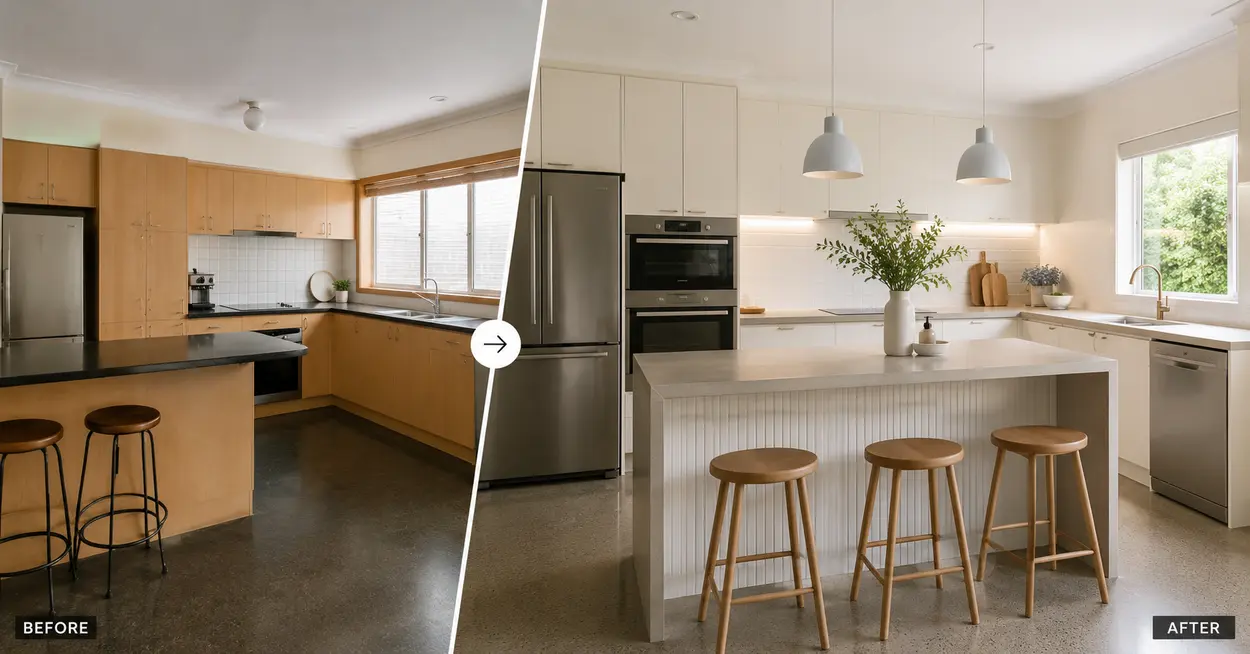
This doesn’t mean your kitchen needs to be boring. It means building your foundational elements — cabinetry, benchtops, flooring — in timeless, versatile tones, then expressing personality through easily replaceable elements: pendant lights, bar stools, textiles, small appliances, artwork. You can swap a set of pendant lights for $300. You cannot swap your splashback for $300.
Budget impact: Replacing a trendy splashback that you’re over costs $2,000–$5,000. Replacing cabinetry that feels dated can run $15,000–$30,000. Invest in timeless foundations from the start.
4. Poor Lighting Placement
Lighting is consistently one of the most underplanned elements in a kitchen renovation — and one of the most impactful. Homeowners tend to focus on the surface finishes and the cabinetry, then treat lighting as an afterthought at the end of the process. The result is a kitchen where you can barely see what you’re chopping, or where one overhead pendant light looks beautiful but leaves the benchtop in shadow for 90% of cooking tasks.
A well-lit kitchen needs at least three layers: ambient (overall room illumination), task (direct lighting over work areas like benchtops and the cooktop), and accent (decorative lighting that enhances the atmosphere). Most renovation mistakes involve relying entirely on ambient lighting alone — a few downlights in the ceiling — without any consideration for where the shadows fall when you’re actually standing at the bench.
Under-cabinet LED strips or downlights are one of the most practical and cost-effective lighting upgrades in any kitchen, yet they’re regularly left off the plans. Kitchen lighting that’s planned at the framing stage — before walls are closed up — costs a fraction of what it costs to retrofit later.
Budget impact: Running electrical during framing: $300–$600 extra. Retrofitting after cabinet installation: $1,500–$3,000+ plus potential damage to new cabinetry. Plan it right the first time.
5. Ignoring Ventilation and Range Hood Selection
Australian cooking is diverse and often aromatic — and without proper ventilation, your beautifully renovated kitchen is going to smell like whatever was cooked three nights ago. Beyond the sensory unpleasantness, inadequate ventilation causes real problems: moisture damage to cabinetry, grease build-up on surfaces, and poor air quality throughout the home.
The most common mistake here is choosing a range hood based on how it looks rather than its extraction capacity. Decorative canopy hoods might look stunning, but if they’re underpowered for your cooktop — or if they recirculate air rather than venting it externally — you’re cooking in a cloud. If you’re using a gas cooktop or doing any serious stir-frying or roasting, a recirculating hood simply isn’t adequate.
The other overlooked element is ducting. Many renovations don’t plan the duct path during the structural phase, which means the contractor improvises later with inefficient duct routes that create noise and reduce extraction effectiveness. Duct runs should be as short and straight as possible, venting directly to the outside.
Budget impact: A good externally-ducted range hood with proper installation: $800–$2,500. Moisture damage to cabinets and walls from inadequate ventilation over a few years: $5,000–$15,000 in repairs.
6. Underestimating Renovation Costs
Budget blowouts are arguably the most common and most stressful kitchen renovation mistake. According to the Housing Industry Association (HIA), the national median kitchen renovation cost sits around $35,000, but it’s rarely that simple. Costs swing dramatically depending on kitchen size, material choices, whether you’re moving plumbing or electrical points, and which city you’re in.
What really catches people off guard are the hidden costs. Asbestos testing and removal in pre-1990 homes. Permit fees that multiply unexpectedly. Waste removal charges. Structural repairs discovered once walls are opened up. The gap between your appliance allowance and what the actual brands you want actually cost. Temporary accommodation if the renovation runs long. These items alone can add 20–30% to a budget that wasn’t padded for them.
| Budget Tier | Typical Spend | What You Get |
|---|---|---|
| Budget | $15,000–$25,000 | Flat-pack cabinetry, laminate benchtops, standard appliances, same layout |
| Mid-Range | $25,000–$45,000 | Semi-custom cabinetry, stone/sintered benchtop, quality appliances, minor layout changes |
| Premium | $45,000–$70,000 | Custom joinery, premium benchtops, integrated appliances, layout redesign |
| Luxury | $70,000–$120,000+ | Fully bespoke fit-out, European appliances, butler’s pantry, structural changes |
Budget impact: A 20% contingency on a $35,000 renovation is $7,000 — which feels like a lot until you actually need it and realise it saved the project. Homeowners who don’t budget contingency often run out of money mid-renovation, leading to rushed decisions and unfinished elements.
7. Hiring Cheap Contractors Without Research
The temptation to go with the cheapest quote is entirely understandable — kitchen renovations are expensive, and saving money feels responsible. But in the trades industry, the cheapest quote is almost always the cheapest for a reason. It might include cheaper materials. It might exclude items the other quotes included. It might come from a contractor who’s underpriced to win work and plans to make it up with variations. Or it might simply reflect poor workmanship that will cost you dearly to fix.
35% of DIY projects and poorly supervised renovations in 2025 eventually required professional fixes, adding cost and time to what was supposed to be a savings exercise. The same logic applies to choosing an unvetted or underqualified contractor over a reputable one.
In Australia, licensed tradespeople are a legal requirement for electrical, plumbing, and gas work. You can verify a contractor’s licence through your state’s relevant authority — NSW Fair Trading, Victorian Building Authority, or QBCC in Queensland. Don’t skip this step. Also check online reviews (Google, HiPages, ServiceSeeking) and ask for two or three references from past clients.
Budget impact: Fixing poor workmanship — re-tiling, fixing incorrectly installed cabinetry, repairing leaking plumbing connections — typically costs 30–50% of the original renovation cost. The “savings” from the cheap quote evaporate immediately.
Smart Kitchen Layout Tips Australians Love
Once you’ve committed to avoiding those mistakes, the next step is designing a layout that genuinely works for how your household lives. Australian homes have some fairly consistent lifestyle patterns — indoor-outdoor living, family-centred cooking, frequent entertaining — and the best kitchen layouts reflect those realities.
The classic work triangle (connecting fridge, sink, and cooktop) remains the gold standard for efficient kitchen workflow. Each leg of the triangle should ideally be between 1.2m and 2.7m, with a total perimeter of 4m to 8m. Going outside those ranges — either too tight or too spread out — creates friction in daily cooking. If you’re designing for two cooks working simultaneously, consider a double-sided island that effectively creates two separate work triangles in one space.
Open-plan kitchens that flow into living or dining areas are still enormously popular in Australia, and for good reason. They allow the cook to stay connected with family or guests rather than being isolated behind a closed-off galley. For this layout to work well, the island bench becomes critical — it acts as a visual and functional boundary between the cooking zone and the living zone while adding prep space, seating, and storage.
If you’re planning a kitchen island, make sure walkway clearances are generous. The minimum clearance on either side of a working island is 900mm; 1050–1200mm is significantly more comfortable when multiple people are moving around. An island that’s too large for the space creates bottlenecks and frustration every day.
For families with young children, pull-out drawers at lower heights, rounded benchtop corners, and accessible pantry storage make a genuine difference to safety and usability. Consider the sight lines too — can you see the backyard from the kitchen window? Can you keep an eye on the kids while you’re cooking? These small functional details matter enormously in a family home.
Best Kitchen Materials for Australian Homes
Material selection is one of the most consequential decisions in any kitchen renovation, and one where Australian conditions create some specific considerations. Our climate — ranging from humid coastal environments to dry inland heat — means not every material that looks good in a European showroom is going to hold up in an Australian kitchen long-term.
For benchtops, the landscape has shifted significantly since engineered stone with high crystalline silica was banned in Australia from 1 July 2024 under Safe Work Australia regulations due to silicosis risk to workers. This has pushed most of the market toward porcelain slab (brands like Dekton and Laminam), sintered stone (Neolith), and natural stone alternatives like marble and granite. Low-silica engineered products (under 1% silica content) remain legal and are available from select suppliers. Choosing the right countertop material involves balancing cost, durability, and maintenance requirements for your specific household.
| Material | Cost (Installed/m²) | Durability | Maintenance | Best For |
|---|---|---|---|---|
| Laminate | $200–$500 | Moderate | Low | Budget renovations, rental properties |
| Porcelain Slab | $800–$1,800 | Very high | Low | High-traffic family kitchens |
| Sintered Stone | $900–$1,800 | Very high | Very low | Outdoor kitchens, heavy use |
| Natural Stone (Granite) | $700–$2,000 | High | Moderate (sealing) | Premium kitchens, unique look |
| Solid Timber | $600–$1,500 | Moderate | High (oiling) | Warm, organic aesthetic |
| Stainless Steel | $500–$1,200 | Very high | Moderate | Professional-style kitchens |
For cabinetry finishes, matte and satin polyurethane have largely replaced high-gloss in Australian kitchens over the past few years — they’re more forgiving of fingerprints and scratches, and they tend to date less quickly. Two-pac paint finishes offer exceptional durability and a smooth, consistent colour across the entire kitchen. Timber veneer cabinetry brings warmth and texture that paint can’t replicate, and it’s particularly well-suited to Australian interiors that lean toward natural, organic aesthetics.
For flooring, durability is paramount in a kitchen. Porcelain tile is the workhorse choice — hard-wearing, water-resistant, available in a huge range of looks, and easy to clean. Luxury vinyl plank (LVP) has become increasingly popular as a more comfortable underfoot alternative, with excellent water resistance and a convincing timber look. Engineered hardwood can work in a kitchen but requires more careful maintenance around moisture. Polished concrete, while stunning, needs to be sealed properly and can be cold underfoot in winter months.
For splashbacks, pressed tin is having a moment in Australian kitchens as a nod to heritage aesthetics, while large-format tiles with minimal grout lines are winning on both the style and easy-maintenance front. Mirror splashbacks make small kitchens feel larger but require more frequent cleaning. Whatever you choose, make sure the material can withstand heat and moisture over the long term — this is not a place to prioritise novelty over practicality.
How to Budget Properly for a Kitchen Renovation
Budgeting for a kitchen renovation is part science, part art, and part honestly acknowledging what you don’t know. Start with a realistic number based on your kitchen size and the tier of finish you’re aiming for, then work backwards to understand what compromises you might need to make.
The biggest mistake people make is trying to get a premium kitchen at a mid-range budget by squeezing every line item. The result is usually a kitchen that looks like it was compromised everywhere — rather than one where smart decisions were made about where to invest and where to save. The better approach is to decide early on which elements you care most about and invest there, then make calculated savings on everything else.
Where to invest: cabinetry quality (you interact with your cabinets hundreds of times per day), benchtop material (it sets the tone for the whole kitchen), and key appliances like your cooktop and oven. Where you might save: splashback (choose something classic rather than expensive), handles (easily upgraded later), and pendant lights (swappable without a tradie). If you’re considering smart home upgrades as part of your renovation, factor these into your budget early — retrofitting technology after cabinetry is installed is much harder.
| Cost Component | Typical % of Budget | Budget Range ($35K mid-range) |
|---|---|---|
| Cabinetry & joinery | 30–45% | $10,500–$15,750 |
| Benchtops | 10–15% | $3,500–$5,250 |
| Appliances | 15–25% | $5,250–$8,750 |
| Labour & installation | 15–25% | $5,250–$8,750 |
| Plumbing & electrical | 8–12% | $2,800–$4,200 |
| Splashback & tiling | 3–8% | $1,050–$2,800 |
| Lighting & hardware | 3–6% | $1,050–$2,100 |
| Contingency (always include) | 15–20% | $5,250–$7,000 |
One more thing: be very careful about making changes mid-renovation. Every time you ask your contractor to change something after the plans are locked in, it comes with a variation cost. “Can we just move the sink 300mm to the left?” can easily cost $1,500–$3,000 in plumbing changes. Make every decision before the hammer hits the wall.
Common Kitchen Design Trends in Australia for 2026
Design trends in 2026 are continuing a shift that’s been building for a few years — away from the cold, sterile minimalism of the early 2020s and toward kitchens that feel warm, tactile, and genuinely inviting. Australians are increasingly interested in spaces that feel good to be in, not just impressive to photograph.
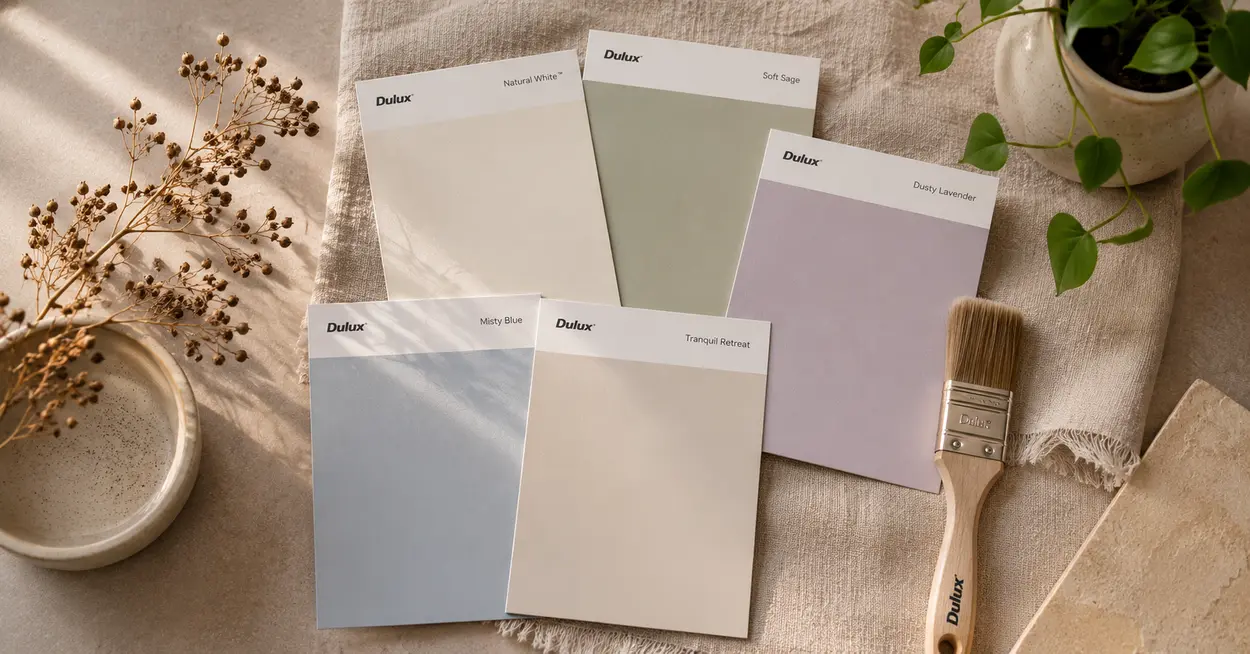
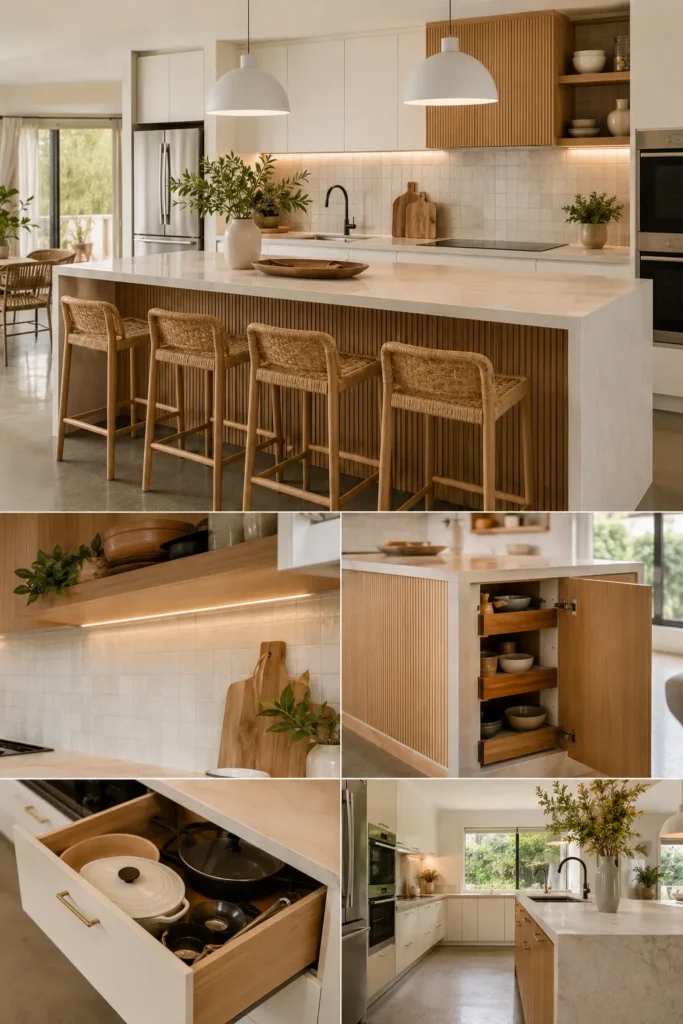
Warm neutral palettes are dominating — think sandy beiges, creamy whites, warm greys, and soft sage greens rather than the stark white and charcoal combinations that peaked a few years back. These tones pair beautifully with natural timber accents, whether that’s a timber island bench, open shelving in spotted gum, or timber-look veneer cabinetry. The effect is a kitchen that feels organic, settled, and liveable.
Minimalist layouts with handleless cabinetry remain popular, but the cold monochromatic version is softening. Push-to-open mechanisms and integrated finger pulls give clean lines without the stark feeling, and they pair well with mixed material approaches — perhaps handleless uppers with hardware on the lower drawers for contrast.
Large kitchen islands continue to grow in size and ambition. In 2026, we’re seeing more islands with built-in appliances (a second sink, a beverage fridge, a pop-up power point), seating on one or two sides, and feature lighting above that treats the island as a focal point in its own right. For families and entertainers, the island has effectively replaced the separate dining table in many open-plan homes.
Smart kitchen technology is moving from novelty to expectation. Smart home upgrades including induction cooktops with app connectivity, refrigerators with interior cameras, and integrated home automation for kitchen lighting are appearing in more mid-range renovations, not just luxury builds.
Sustainable materials are also influencing choices. Green living principles are showing up in material selections — recycled timber benchtops, FSC-certified cabinetry, and energy-efficient appliances are increasingly prioritised by eco-conscious Australian homeowners. The ban on high-silica engineered stone has accelerated this shift toward alternative materials that are safer and often more environmentally considered.
DIY vs Professional Kitchen Renovation: What Australians Need to Know
The appeal of DIY kitchen renovation is easy to understand — flat-pack kitchens from retailers like Kaboodle or IKEA have made self-installation genuinely accessible for handy homeowners, and the potential labour savings are real. For a modest renovation within an existing layout, a capable DIYer can save $5,000–$15,000 in installation costs. But there are firm limits, and ignoring them is a significant risk — financially, legally, and in terms of safety.
What’s generally fine for DIY: painting, installing flat-pack cabinetry (if you’re confident and patient), tiling, replacing light fittings on existing circuits, and cosmetic upgrades like swapping hardware or installing a new splashback. These tasks require skill and time, but no licensed trade qualifications.
What’s absolutely not for DIY in Australia: anything involving electrical wiring (even swapping a power point location), gas connections or disconnections, structural wall removal, or plumbing rough-in and relocation. These require licensed tradespeople by law, and DIY work on these elements is not only unsafe — it voids your home insurance and creates significant problems at the time of property sale. As the research shows, 35% of DIY projects in 2025 eventually required professional fixes, often costing more than hiring a professional from the start.
✓ DIY Kitchen Renovation
- Significant labour cost savings
- Full creative control
- Good for cosmetic upgrades
- Satisfying if skills match the scope
✗ DIY Kitchen Renovation
- Illegal for electrical, gas, plumbing
- Time-intensive (often underestimated)
- Mistakes are costly to fix
- Can void home insurance
The sweet spot for most homeowners is a hybrid approach: hire a qualified kitchen designer and project manager, use licensed tradespeople for all technical work, and handle cosmetic tasks like painting or minor tiling yourself if you have the skills and time. This approach can reduce labour costs meaningfully without any of the legal or safety risks of DIY electrical or plumbing work.
Quick Tips to Reduce Kitchen Renovation Stress
Even a well-planned renovation has its challenging moments. The best way to protect your sanity is to anticipate the friction points and have strategies for each one before they arrive.
Start by establishing a temporary kitchen setup before demolition begins. A camping stove, a microwave, a kettle, and a bar fridge in the laundry room or garage is enough to get through most of a renovation. Knowing you can make a coffee and heat up dinner removes an enormous amount of daily stress. Stock up on easy meal options and make peace with the fact that takeaway will feature fairly heavily for a few weeks.
Communicate clearly and regularly with your contractor. Agree on a communication method — whether it’s a daily text update, a weekly site meeting, or a shared progress app — and stick to it. Contractors who go quiet are a warning sign. You should know what’s happening on your site every day, even if it’s just “waiting for the benchtop delivery tomorrow.”
Order all materials and appliances before demolition begins, not after. Supply chain delays are real, and a kitchen that’s fully demolished and waiting six weeks for a backordered splashback tile is both stressful and expensive (particularly if you’re paying rent on temporary accommodation). Confirm delivery timelines for every item before your contractor swings the first crowbar.
Resist the urge to make changes mid-project. Every change costs money and time — usually more of both than you’d expect. If you have second thoughts about a decision, raise it with your designer before work starts on that element. Once cabinetry is installed or tiles are laid, “changing your mind” becomes a very expensive proposition.
And finally: keep your expectations grounded about the timeline. Most kitchen renovations in Australia take four to eight weeks for a standard-sized kitchen without major structural changes. Complex renovations with layout changes, structural work, or custom elements can run three to five months. Build in buffer time, particularly if you have a hard deadline like a property sale or a family event.
Frequently Asked Questions
1. What is the biggest kitchen renovation mistake Australian homeowners make?
The most common and costly mistake is prioritising looks over functionality — designing a kitchen around a particular aesthetic without properly considering how the household actually cooks and lives in the space. This leads to poor workflow, inadequate storage, and a kitchen that’s beautiful but genuinely frustrating to use every day.
2. How much should Australians budget for a kitchen renovation in 2026?
The realistic range for a standard mid-range kitchen renovation in Australia is $25,000–$50,000, with the HIA national median sitting around $35,000. Budget renovations using flat-pack cabinetry can come in under $25,000 if you keep the same layout. Premium and luxury kitchens often exceed $70,000. Always add a 15–20% contingency buffer on top of your quoted total to cover hidden costs and unexpected discoveries.
3. Are open-plan kitchens still popular in Australia in 2026?
Yes, very much so. Open-plan layouts that connect the kitchen to the living or dining area remain one of the most sought-after design configurations in Australian homes. They align well with the Australian preference for indoor-outdoor living and family-centred entertaining. The island bench plays a key role in making open-plan kitchens functional — it delineates the cooking zone without creating visual or physical barriers.
4. Which kitchen layouts work best for Australian families?
L-shaped and U-shaped layouts with a central island work extremely well for families, as they provide multiple work zones that allow more than one person to cook simultaneously. The island adds prep space, seating for kids, and extra storage. Open-plan layouts with generous walkway clearances (at least 900mm, ideally 1050–1200mm) accommodate busy family movement without congestion.
5. Is DIY kitchen renovation worth it in Australia?
DIY can be worthwhile for cosmetic upgrades — painting, flat-pack cabinetry installation, tiling, and hardware changes. However, any work involving electrical, gas, plumbing, or structural changes must be done by licensed tradespeople by law. Given that 35% of DIY renovation projects eventually require professional fixes (often more expensive than hiring a professional initially), a hybrid approach — DIY for cosmetic elements, professional trades for everything technical — is usually the most cost-effective strategy.
6. What kitchen trends are popular in Australia in 2026?
The dominant trends include warm neutral colour palettes (creamy whites, sandy beiges, soft sage greens), natural timber accents, large handleless islands, porcelain slab benchtops (following the engineered stone ban), integrated smart appliances, sustainable material choices, and open shelving for displaying everyday items. The overall aesthetic is shifting from cold minimalism toward warmth, texture, and liveable elegance.
7. How can I save money during a kitchen renovation without compromising quality?
Keep the same layout (moving plumbing and electrical is expensive), choose semi-custom cabinetry over fully bespoke, pair a premium benchtop with cost-effective laminate cabinetry, shop for appliances during sales, handle painting and minor tiling yourself if capable, and choose classic splashback materials rather than novelty ones. Avoid making changes mid-project — variations are where budgets blow out fastest.
8. Which kitchen upgrades add the most value to an Australian home?
Kitchen renovations consistently deliver the highest ROI of any home improvement — up to 75% return according to Melbourne real estate data. Within a kitchen renovation, the upgrades that add the most value are quality cabinetry (particularly custom or semi-custom joinery), premium benchtops, integrated appliances, and a functional layout with generous storage. Buyers and valuers respond well to kitchens that feel functional and timeless rather than trendy and flashy.
Conclusion
A kitchen renovation is one of the most meaningful investments you’ll make in your home — and like all meaningful investments, the outcome depends heavily on the quality of the decisions made before a single tool is picked up. The seven mistakes covered in this guide aren’t rare or unusual. They happen every day in Australian homes across every budget range, from modest flat-pack refreshes to high-end custom builds. The good news is that every one of them is avoidable with the right information and a clear-eyed planning process.
Prioritise function first, then layer in the aesthetics you love. Build storage into the design from the start, not as an afterthought. Choose materials that will age gracefully rather than trend-hop with you. Light your kitchen properly, ventilate it properly, budget for the unexpected, and hire contractors whose track record you’ve actually verified. These aren’t complicated principles — but in the excitement of designing a new kitchen, they’re surprisingly easy to overlook.
The kitchens that Australians love most five, ten, and fifteen years later are almost never the ones that were the most photographable at completion. They’re the ones where every morning runs smoothly, where the storage actually fits everything, where the lighting is warm and inviting, and where the layout makes cooking feel easy instead of effortful. That’s the kitchen worth building.
Take your time with the planning phase. Ask the hard questions. Get the details right before the work begins. Your future self — loading the dishwasher on a Tuesday night, happy with every decision made — will thank you for it.